
How much does it cost to build a vacation home in Thailand?
A fitted vacation home in Thailand can be budgeted from a published house price plus site costs. INK's Sati M, a 79 m² one-bedroom home, starts from ฿2,900,000 and the 113 m² Sati L from ฿4,100,000, both excluding VAT. Land, VAT, site preparation and utilities come on top.
The most reliable way to budget a vacation home in Thailand is to start from a complete, published house price and then add the costs that depend on your land. Per-square-metre figures quoted online vary widely and rarely say what they include, so they are a weak basis for a real budget.
This guide uses INK's Sati homes as a worked example, because their prices and inclusions are published. The same method works for any builder: confirm what the house price covers, then list the land, tax and site costs separately.
What does a fitted vacation home cost in Thailand?
At INK, a fitted Sati M of 79 m² starts from ฿2,900,000 and a Sati L of 113 m² from ฿4,100,000, both excluding VAT. With VAT at 7%, that is ฿3,103,000 and ฿4,387,000. Land, site preparation, utility connections and permit costs are budgeted separately, because they depend on the plot.
| Model | Area | Bedrooms | From (excl. VAT) | With 7% VAT | Build time |
|---|---|---|---|---|---|
| Sati M | 79 m² | 1 | ฿2,900,000 | ฿3,103,000 | Within 4 months from contract |
| Sati L | 113 m² | 2 | ฿4,100,000 | ฿4,387,000 | Within 4 months from contract |
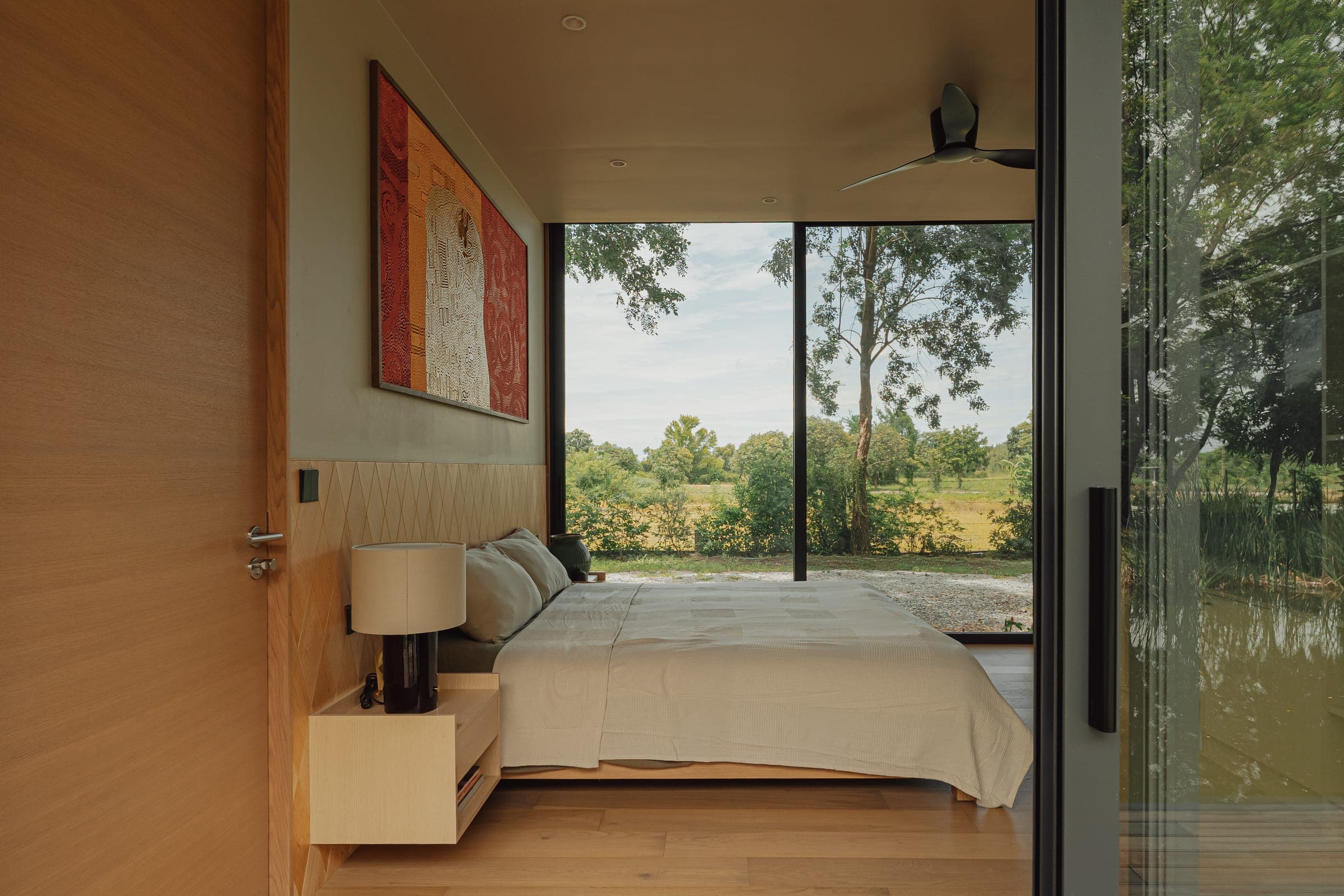
Because the price is for a home you can move into — air conditioning, built-in furniture in every room, kitchen appliances and sanitary ware are included — it is not directly comparable with a quote for a structure alone. The full breakdown is in our guide to what a modular home costs in Thailand.
What extra costs are often missed when budgeting in Thailand?
The most frequently missed costs are site preparation, utility connections, permits, furniture, landscaping, and transport to remote plots. These items can add a meaningful percentage to the base contract, so buyers should separate the house build price from the full project budget before approving drawings, financing, or construction schedules.
Common extras include soil testing, piling, stronger foundations, cut-and-fill work, drainage, retaining walls, septic tanks, water storage, pumps, meter applications, boundary walls, and driveway works. On hillside, island, or narrow-road sites, crane access and material handling can add noticeable cost. Buyers should also clarify VAT, professional fees, temporary works, and utility authority charges before comparing quotations.
How do location and site conditions affect the cost?
Location changes cost through labor availability, transport distance, permitting practices, and engineering requirements. Flat plots near Bangkok, Chiang Mai, or Phuket supply chains are usually easier to price than steep, remote, or island sites, where logistics, drainage, retaining walls, and service connections can raise total cost significantly before the superstructure begins.
A build in Phuket, Koh Samui, or mountainous northern areas may carry higher logistics and weather-management costs than a similar home in a well-connected inland province. Remote plots often need more coordination for concrete delivery, steel handling, and waste removal. Soil conditions matter too: weak ground, flood risk, or steep grades can require upgraded foundations, which changes both structural pricing and the construction sequence.
Is modular construction cheaper than conventional building in Thailand?
Modular construction in Thailand can be cheaper in some cases, but its main advantage is often cost certainty, speed, and factory quality control rather than a guaranteed lower headline rate. Savings are most likely when designs are standardized, production is efficient, and the site would otherwise cause delays, rework, or labor waste.
Factory-built modular homes can reduce weather delays, material waste, and on-site labor inefficiency. That can help stabilize budgets, particularly for repeatable designs and tighter delivery timelines. However, transport, cranage, installation, and foundation coordination still matter. A conventional build may appear cheaper if specifications are stripped back, so buyers should compare structure, finishes, insulation, MEP scope, and installation on a like-for-like basis.
For overseas owners, modular delivery can also simplify project management because more work happens under controlled conditions. That does not remove the need for permits, utility planning, or site preparation, but it can reduce uncertainty around sequencing and workmanship. Suppliers, fabricators, and local authorities still need to align on access, code compliance, and final utility hookups.
A shorter build also lowers the costs that run while a home is unfinished, such as trips to supervise the site and rent elsewhere. INK completes a Sati home within four months from contract; see modular vs traditional construction.
What should be included in a reliable Thailand vacation home quote?
A reliable quote should clearly define structure, wall system, roof build-up, windows, bathrooms, kitchen allowance, MEP systems, foundations, transport, installation, and exclusions. The more explicit the inclusions schedule, the easier it is to compare builders fairly and avoid low starting prices that later expand through provisional sums or variations.
Ask for a written scope covering structural steel or reinforced concrete, insulation, waterproofing, sanitaryware, lighting points, distribution board, air conditioning readiness, water tanks, pumps, septic provision, and external steps or decks. Clarify what is excluded, including land costs, permit fees, landscaping, loose furniture, appliances, and utility authority charges.
It is also sensible to ask whether the quote reflects municipal submission support and local code expectations. Guidance from the Department of Public Works and Town & Country Planning can shape compliance requirements. A detailed inclusions sheet usually gives buyers a more reliable basis for comparison than a single headline price.
Key takeaways
- Start a vacation home budget from a complete, published house price rather than an unexplained per-square-metre rate.
- INK's Sati M starts from ฿2,900,000 and Sati L from ฿4,100,000, excluding 7% VAT, fitted and ready to live in.
- Land, VAT, site preparation, utility connections and permits sit outside the house price and depend on the plot.
- Remote, steep, island or weak-soil plots usually cost more because access, drainage and foundations become harder.
- A reliable quote states inclusions, exclusions, foundation assumptions and installation responsibilities in writing.
Frequently asked questions
How much does a small vacation home cost to build in Thailand?
INK's Sati M, a 79 m² one-bedroom home with a walk-in closet, starts from ฿2,900,000 excluding VAT and is completed within four months from contract. The price includes air conditioning, built-in furniture, kitchen appliances and sanitary ware. Land, site preparation and utility connections are budgeted separately.
Does the Thailand build cost usually include land?
No. Most quoted build rates in Thailand refer to construction only, not land purchase. Buyers should usually budget separately for the plot, legal due diligence, utility applications, permit-related expenses, furniture, and landscaping. Asking for an itemized split between house cost and project extras makes quotations much easier to compare.
Is it cheaper to build in rural Thailand than in Phuket or Koh Samui?
Often yes, but not automatically. Rural mainland areas may have lower labor and logistics costs, while Phuket, Koh Samui, or remote mountain sites can be more expensive because of transport, access constraints, and site engineering. The true difference depends on road access, utility distance, soil conditions, and material availability.
How much contingency should I keep for a vacation home build in Thailand?
Many owners keep a contingency of around 10 to 15% of the build budget for unknown ground conditions, utility upgrades and changes they decide to make. If the site is remote, steep or lightly surveyed, a larger margin is sensible until the foundation design and access route are confirmed.
Are modular homes always cheaper than conventional homes in Thailand?
No. Modular homes are not always cheaper on headline price alone. Their advantage is often more predictable cost, faster delivery, and better factory quality control. They can save money when designs are standardized or when on-site construction would suffer from delays, waste, rework, or difficult site conditions.
Sati prices and inclusions come from the INK Homes SATI catalogue and exclude VAT. Site, land and permit costs vary by plot and are not quoted here. This guide is general budgeting information, not a quotation. Drafted with AI assistance and reviewed against INK's published information. Published by INK Homes.